
To get the biggest bang for your buck – and to have the most impact – Integrative Design is what you need.
Weprobably all remember the early days of the energy and carbon transition – most of us had it back to front. Trying to band-aid our energy consumption with solar and offsetscaused all kinds of issues, from distorting the payback of energy efficiency, to increasing landfill and embodied emissions, buying more solarthan you need, and getting bad press for greenwashing.
These days we've learned, through the Energy Hierarchy, that energy efficiency is "The First Fuel" – the cheapest, and fastest, way to reduce energy and emissions. Because the cheapest energy is the energy you don't use.
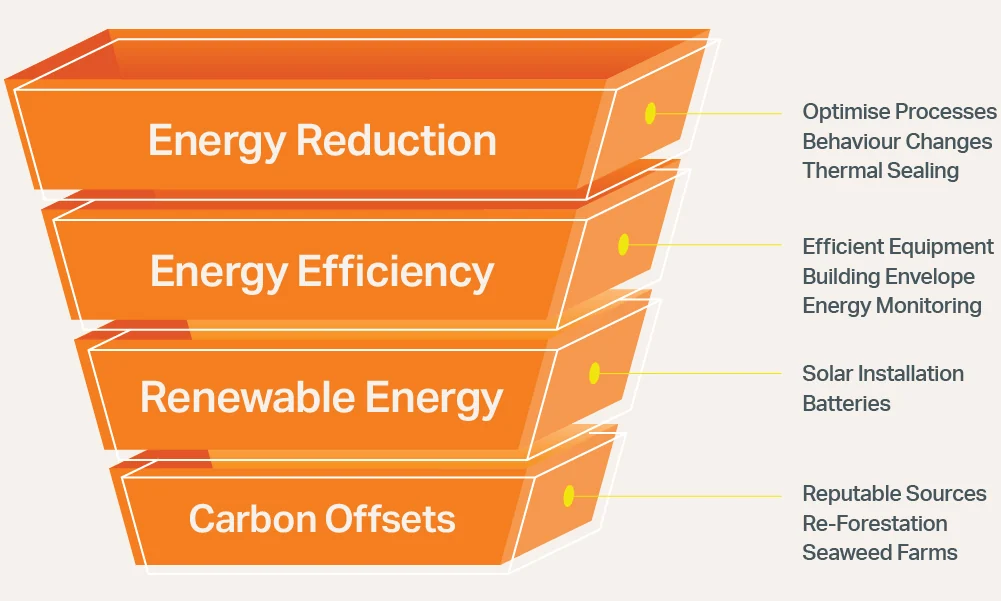
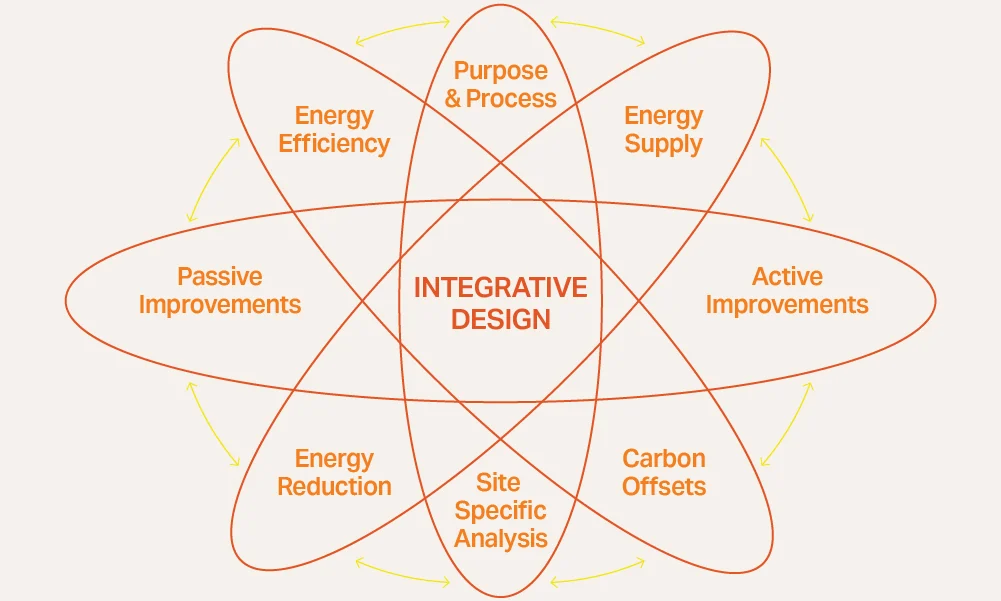
Integrative Design shares a similar principle structure as the Energy Hierarchy, but it is the implementation that differs.Integrative means using systems-thinking to design and implement multiple solutions at once.
Each measure considers and compliments the others allowing both individual parts, and the system as a whole, to operate more effectively. So, instead of looking at individual technologies in isolation, Integrative Design optimally combines multiple technologies in a way that allows each one to improve the ROI of the others.
Replacing old air conditioners, and/or adding smart controls and motion sensors, is a simple and cost effective addition when upgrading your lights to energy efficient LED. LED lights produce far less heat than older technologies, which reduces the load on air conditioners (a 100W Halogen light in Queensland adds an extra 17W load to your air conditioner).
Fixing roof leaks, and installing insulation and reflective roof paint at the same time as installing solar panels is a great example of integrative design, since you'll be accessing the roof for solar anyway. Sealing gaps and adding a good insulation can significantly increase the thermal envelope of your building, while reflective roof paint will help keep the ceiling cavity below 40°C (a metal roof in Australia can easily get over 100°C).
While LED lighting upgrades and solar panels are well-proven, easy to calculate – and subsidised, they shouldn't be looked at in isolation, and aren't necessarily the best first option to reduce energy consumption. The best ROI can actually be found in behaviour changes – because they are free. We've all been told to turn the lights off when leaving a room, but what about turning your air conditioner off when you go out for lunch? Or restocking a cool room earlier/later in the day when it's not as hot? What about using cheaper, off-peak electricity to heat your water? Simple operations adjustments can have a big impact on your energy bill, while helping you both identify issues you may not have known about previously, and introduce creative ways to solve them.
Improvements to your buildings thermal features can also have a great ROI. Things like installing insulation, weather seals, cold room curtains and block out blinds are relatively low-cost and help reduce the amount of energy you need for heating and cooling – because it will no longer be escaping out the door (or hole in the wall).Another simple, low-cost option is to add controllers. We have found the biggest energy users for most of our clients are lighting and air conditioning, and we offer easy to implement controls for both.Temperature
However even these options are best done using Integrative Design to avoid missing other energy saving opportunities.
Install skylights where possible while doing an LED lighting upgrade so that you can also install daylightsensors on your lights to dim them, or turn them off when it's sunny.
If you're adding a building extension, consider installing occupancy sensors on existing air conditioners and lights to balance the added electrical load. Meaning you won't need to upgrade the switchboard.
We work with you on continual improvement, and keep you up to date with government grants and new technologies.
If unchecked, energy waste can significantly hinder the profitability and operational efficiency of your organisation. Partnering with an ESCO like Austep can transform how you manage energy, turning what is often an overlooked aspect of your business into one of your strongest assets.
You’re already spending this money. The problem is that it goes straight to your power company, and you get nothing back for it.Put that same money into energy improvements instead, and for the first few years you spend no more than you do today. The difference is that now you’re getting something for it. Once the upgrades pay for themselves (say, in year three), the savings stay in your account.Worried about cashflow? Green Finance programs can cover the cost of the upgrades, so there’s no upfront capital outlay. The energy savings repay the investment, which means your cashflow is positive from day one.
Achieving energy efficiency through Integrative Design can seem like a daunting task. Deciding the optimal order of implementation, while juggling multiple systems and intricate components, can make the whole process confusing and messy. This is where Austep's AS 3598 Energy Auditing Service can help. By conducting a site-specific analysis of your building or facility, our team of experts create a comprehensive breakdown of your energy use and where it's being wasted. We then develop a step-by-step, cost-effective strategy to achieve the most energy (and monetary) savings. Our team will also oversee the project and coordinate with contractors and suppliers to ensure the process runs smoothly, to the highest standards of quality and safety, and with minimal disruption to your operations.
Achieving energy efficiency through Integrative Design can seem like a daunting task. Deciding the optimal order of implementation, while juggling multiple systems and intricate components, can make the whole process confusing and messy. This is where Austep's AS 3598 Energy Auditing Service can help. By conducting a site-specific analysis of your building or facility, our team of experts create a comprehensive breakdown of your energy use and where it's being wasted. We then develop a step-by-step, cost-effective strategy to achieve the most energy (and monetary) savings. Our team will also oversee the project and coordinate with contractors and suppliers to ensure the process runs smoothly, to the highest standards of quality and safety, and with minimal disruption to your operations.
Austep offers comprehensive energy-efficient lighting solutions that not only reduce glare but also contribute to long-term sustainability. With our expertise in LED lighting upgrades and a focus on smart, repairable products, we are committed to enhancing the appearance, performance and safety of your buildings while minimising energy and maintenance costs.


